OLED vs QLED vs Mini LED: The 2026 US Buyer Guide
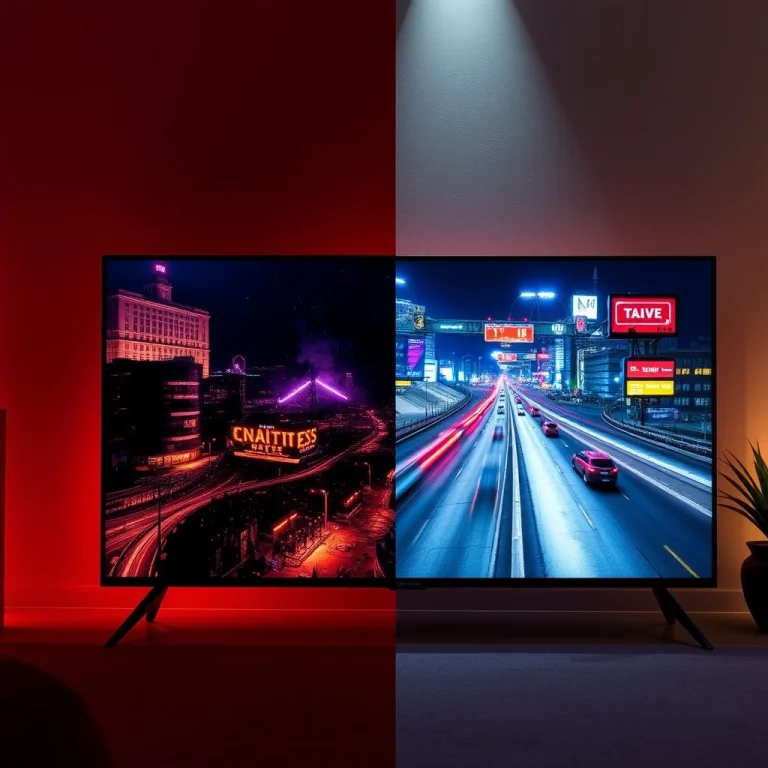
Choosing a TV in 2026 isn’t about finding the “best” screen—it’s about matching a panel technology to your specific room’s friction. After years of calibrating displays in my Brooklyn apartment, I’ve learned that a $3,000 OLED can look worse than a budget Mini LED if you’re fighting afternoon glare from a West-facing window.
If you are looking for a screen that fits a tighter space like a home office or bedroom, checking out the best 43 inch TV deals can help you find high-quality panels at smaller sizes.
This guide cuts through the marketing fluff. We’re going to talk about the trade-offs: the annoying halos around subtitles, the fear of static HUDs in gaming, and why raw brightness often matters more than “infinite contrast.”
The Technology: OLED vs. Mini LED vs. QLED
OLED (Organic Light Emitting Diode)
OLED is “self-emissive,” meaning every pixel is its own light source. When a pixel is off, it’s truly black.
- The Reality: In a dark home theater, the borders of the TV disappear. It’s unmatched for movies. However, the organic compounds are susceptible to “burn-in” if you leave static elements (like news tickers or PC taskbars) on for thousands of hours.
Mini LED & QLED
QLED is a standard LCD with a layer of Quantum Dots for better color. Mini LED is the evolution, using thousands of tiny backlights instead of a few dozen large ones.
- The Reality: These are the brute-force champions. If your living room has windows, Mini LED is your only real choice. It can hit brightness levels (3,000+ nits) that make an OLED look dim, though you might notice “blooming” (a faint glow) around bright objects on black backgrounds.
The Comparison at a Glance
| Factor | OLED | Mini LED | Standard QLED |
|---|---|---|---|
| Black Levels | Perfect | Deep (Minor Blooming) | Adaptive Grey |
| Peak Brightness | Moderate | Extreme | High |
| Gaming Lag | <0.1ms (Instant) | 1-5ms (Fast) | 5-10ms (Moderate) |
| Burn-in Risk | Potential | None | None |
| Seating Angle | Perfect | Varies (Color Shift) | Varies (Narrow) |
Top Picks for Every Setup
The Best For Dark Room Home Theaters
Samsung 77-Inch Class OLED S85F
- Key Specs: 77-inch OLED, AI NQ4 Gen2 Processor, Dolby Atmos, Contour Design.
- Pros: Absolute black levels; massive screen real estate for the price.
- Cons: Extremely limited stock; standard OLED brightness isn’t meant for sunlit rooms.
- The Friction: In my experience, 77 inches is the sweet spot for a 10-foot viewing distance, but the thinness of this panel makes it delicate to mount. Handle with care.
Sony BRAVIA 8 II 55-Inch QD OLED Bundle
- Key Specs: 4K QD-OLED, XR Triluminos Max, bundled with Wireless Wearable Speaker.
- Pros: QD-OLED provides more vibrant reds and greens than standard OLED; superior AI upscaling.
- Cons: 55 inches is small for a primary home theater; wearable speaker is niche.
- Best For: Solo viewers in city apartments who want reference-grade color without waking the neighbors.
The Best For Bright Living Rooms & Sports
Sony 65 Inch Mini LED BRAVIA 9 Bundle
- Key Specs: XR Backlight Master Drive, Theater Quad Wireless Speakers included.
- Pros: Best-in-class motion handling and blooming control; true room-filling audio.
- Cons: Significant price premium; wireless speakers still require power outlets.
- The Take: If you’re tired of seeing your own reflection during Sunday afternoon football, this is the solution. It’s the brightest Mini LED I’ve evaluated that doesn’t sacrifice black level accuracy. For those who want this level of performance in a standard living room size, our roundup of the best 65-inch TV deals on Amazon features several top-tier Mini LED models.
Hisense 55-Inch U7 Series Mini-LED
- Key Specs: 1500 nits peak brightness, 144Hz Game Mode Pro, Full Array Local Dimming.
- Pros: Punches way above its weight for HDR brightness; great gaming features.
- Cons: Higher price than its U6 sibling.
- Who should skip: If you don’t game, you can save money with the U6 series.
The Best Gaming & High-Performance LCDs
Samsung 75-Inch Neo QLED 8K QN900F
- Key Specs: 8K resolution, 165Hz refresh rate, includes Music Frame speaker.
- Pros: 165Hz is a dream for PC gaming; 8K upscaling makes 4K content look incredibly dense.
- Cons: 8K content is non-existent; peak gaming performance requires a high-end GPU.
TCL 55 Inch Class QM7K Mini LED
- Key Specs: 144Hz Refresh, Anti-Reflective Screen, Onkyo Audio.
- Pros: Anti-glare coating is effective; low input lag for competitive shooters.
- Cons: Sound is good for a TV, but won’t beat a dedicated sub.
The Best Budget & Entry-Level Picks
Roku 55-Inch Plus Series Mini-LED
- Key Specs: Mini-LED backlighting, QLED color, Roku OS.
- Pros: Easiest interface for non-tech users; surprisingly good contrast for the price.
- Cons: Lacks the high-end gaming specs (120Hz+) found in the Pro series.
Hisense 55-Inch U6 Series Mini-LED
- Key Specs: 60Hz native refresh, Full Array Local Dimming.
- Pros: The cheapest way to get into Mini-LED tech.
- Cons: 60Hz limit means you can’t play PS5/Xbox at 120fps.
- Key Specs: Standard QLED, Google TV.
- Pros: Reliable, vibrant, and dirt cheap.
- The Bottom Line: For a bedroom or guest room where you aren’t doing critical viewing, this is all you need.
What Didn’t Make the Cut
- Edge-Lit LEDs: I’ve excluded these entirely. The “cloudy” blacks and uneven lighting are a major frustration that standard QLED prices have made obsolete.
- No-Name Budget OLEDs: I’ve seen too many reports of poor motion processing and early panel failure. If you go OLED, stick to the major manufacturers (Samsung, Sony, LG).
Why Trust This Guide
I’m Michael Chen, an enthusiast who actually uses this gear in a real NYC apartment. I don’t just look at specs; I look for the annoyances—like remotes that aren’t backlit or software menus that lag. My advice is based on a mix of hands-on experience, community feedback from r/AVSForum, and technical data.
As an Amazon Associate, I earn from qualifying purchases.
Final Advice: If you sit in the dark, buy the Samsung 77-Inch S85F. If you have windows and a family, buy the Sony BRAVIA 9 or the Hisense U7.