The unsexy truth that every home barista eventually learns the hard way.
If you’re researching espresso equipment, you’ve probably hit this advice already: spend more on your grinder. But here’s what the standard buying guides don’t explain well—the reason behind that advice, and why it’s even more true than you think.
I’ve been there. You spend six months saving up, agonize over boiler specs and pressure profiles, join the subreddit and read every thread about flow profiling. And then someone at your local roastery mentions—almost casually—that they pulled a better shot on a $300 machine with a $700 grinder than anything you’d managed at home.
That conversation started a rabbit hole that changed how I think about equipment entirely. After eight years of brewing, roasting, and obsessing over coffee from a beaten-up La Pavoni to a single-group Linea Mini, I’ve come to a conclusion the specialty coffee world has known for decades but that home enthusiasts often resist: your grinder determines your ceiling. Your machine just determines how close you get to it.
This isn’t about gatekeeping or telling you to spend more money. It’s about where your marginal dollar actually goes. Once you understand why grind consistency matters more than pressure profiling, you’ll make better equipment decisions—and probably save some money in the process.
About This Guide
I’m Sarah Miller—a coffee enthusiast, home roaster, and café hopper based in Portland, Oregon. I’ve been brewing, roasting, and obsessing over coffee for eight years. My daily setup has included everything from a vintage La Pavoni I’ve restored twice to dialing in light-roast Ethiopians on third-wave café equipment.
This guide reflects that journey: the expensive mistakes I’ve made, the equipment I’ve returned, and the insights that only come from living with grinders over months—not just testing them for an afternoon. Some observations here are from grinders I’ve used extensively in my own kitchen. Others synthesize buyer feedback and long-term owner reports when I haven’t had extended hands-on time. I’ll be clear about which is which.
Why You Should Trust Our Picks
When I evaluate grinders, I’m not running lab tests with particle size analyzers. I’m making espresso and pour-over in my home kitchen, on my own counter, with my own beans and my own workflow. That’s the testing methodology: real use over extended time.
For this guide, I’ve focused on grinders that perform well in three areas that actually matter for home use:
Extraction consistency. Does the grinder produce uniform particle sizes, or are you getting a mix of fines and boulders that channel your extraction?
Retention and freshness. How much coffee sits in the grinding pathway between doses, and does it affect your next shot?
Workflow sustainability. Will you actually use this grinder every day, or will the friction drive you to worse coffee because you avoid the process?
I haven’t tested every grinder on the market, and I won’t pretend I have. What I’ve tested are the grinders that keep appearing in serious home barista conversations—models that earn reputation over years, not weeks. If a grinder isn’t in this guide, it might still be excellent. It probably just isn’t what I reach for, or it fell short in one of the three areas above.
The Extraction Problem Nobody Talks About
Here’s what actually happens when hot water meets coffee grounds.
Water doesn’t extract uniformly. It follows paths of least resistance. When your grounds have a wide particle size distribution—when some particles are twice as large as others, or you have both powdery fines and chunky boulders—water will preferentially flow through the easy routes. Fine particles pack tightly and restrict flow. Large particles create voids. The result is channeling: water blasting through certain zones while barely touching others.
This matters because extraction is a solubility problem. Fine particles over-extract before the water moves on. They give up their bitter, astringent compounds while the rest of your bed is still warming up. Coarse particles under-extract. They contribute sour, underdeveloped flavors while the fines are already turning harsh.
A good grinder minimizes this problem. It creates a narrow particle size distribution where most grounds fall within a tight range. This gives you predictable extraction behavior. It means your water contacts similar surface areas at similar rates. It means when you adjust your grind setting, the change affects your entire bed uniformly rather than just shifting where channeling occurs.
No espresso machine can fix this. You can have perfect 9-bar extraction pressure, PID-controlled boiler temperature, and pre-infusion algorithms that would make a NASA engineer jealous—but if your grounds are inconsistent, you’re fighting physics. You’re trying to create uniform extraction from non-uniform starting material.
Burr Geometry: The Engineering That Actually Matters
Not all burr grinders are created equal, and the differences matter more than most buyers realize.
Conical burrs use tapered, cone-shaped grinding surfaces that shear beans progressively as they fall through. They’re efficient, less prone to heat generation, and often produce what enthusiasts call a “unimodal” distribution—that is, a single peak of particle sizes with more fines at the small end. The Niche Zero popularized this design for home espresso single-dosing, and for good reason: the geometry works well for workflow-focused brewing where retention matters.
Flat burrs use parallel discs with cutting teeth along the outer edges. They tend to produce tighter particle size distributions with fewer fines. The trade-off is that they can generate more heat (though modern designs have addressed this significantly), and the cutting geometry requires more precise alignment during manufacturing. Premium home grinders like the Lagom P64 use 64mm flat burrs that deliver exceptional consistency—but the larger diameter and tighter tolerances mean higher cost.
The flavor implications are real but often overstated in enthusiast circles. Flat burrs are frequently described as producing “cleaner” cups, while conical burrs are said to add “body” or “texture.” In my experience, these differences are real but secondary to grind consistency. A mediocre flat burr grinder will produce worse espresso than a well-engineered conical design. The burr type is a design choice with tradeoffs, not a quality hierarchy.
What matters more than conical versus flat is build quality and alignment. Cheap grinders often have burrs that aren’t precisely parallel, producing uneven wear and inconsistent particle sizes. Higher-quality grinders use precision-machined burrs with tighter manufacturing tolerances. The difference shows up in your cup—and in how long the grinder maintains that performance before the burrs dull.
The Fresh Ground Problem
If you’ve ever opened a bag of pre-ground coffee and noticed it smelled muted compared to the whole beans you ground yourself, you’ve experienced one of coffee’s fundamental truths: grinding accelerates degradation dramatically.
Whole bean coffee has a relatively small surface area exposed to oxygen. Grind it, and that surface area explodes. The aromatic compounds that make light-roast Ethiopian coffees smell like blueberry fields? They start off-gassing immediately. The volatile oils that give dark roasts their characteristic nose? They oxidize within hours.
This is why freshness matters so much, and why the specialty coffee world has shifted toward single-dose workflows. A typical hopper-based grinder holds beans at the top, grounds in the pathway below, and grounds in the dosing chamber. If you’re pulling one or two shots per day, you’re potentially using grounds that have been sitting in retention for 12-24 hours. Those grounds have already begun staling before they hit your portafilter.
Single-dose grinders minimize this. You load exactly what you need, grind it, and the grounds go directly into your portafilter. Less retention means less stale coffee affecting your next dose. It also means you’re grinding at peak freshness—the beans haven’t been sitting in a hopper, slowly losing aromatics.
The tradeoff is convenience. Single-dosing takes more time. You have to measure beans, load them, and clean out the pathway between doses if you want to avoid carryover between different coffees. For some people, this friction is acceptable. For others, it’s not sustainable as a daily workflow.
I fall somewhere in between. On weekend mornings, I single-dose and take my time. During the week, I use a grinder with a small hopper and accept that there’s some retention in exchange for faster workflow. The important thing is understanding the tradeoff and choosing intentionally rather than defaulting to whatever came in the box.
Stepped vs Stepless: The Adjustment Reality
Grind adjustment mechanisms are one of those areas where the marketing language often obscures more than it reveals.
Stepped adjustment uses discrete detents—clicks or stops—that move the burrs a fixed distance. This makes it easier to reproduce settings reliably. If you find a setting you like, you can return to it consistently. The tradeoff is limited resolution: you’re limited to whatever increments the manufacturer chose, and some coffees might need a setting that falls between steps.
Stepless adjustment offers infinite tuning. You can dial to any point within the grinder’s range. This gives you more flexibility when dialing in finicky coffees. The tradeoff is that “dialing in” becomes a real skill. Finding a setting you like is easier. Reproducing it exactly the next time requires more care and attention.
Here’s what the marketing doesn’t tell you: for most people grinding for drip, pour-over, or even home espresso, stepped adjustment is probably sufficient. The difference between grind settings matters most when you’re extracting at pressure with a narrow tolerance for error—which is espresso. If you’re primarily brewing immersion methods or drip, the resolution difference between stepped and stepless is negligible.
For espresso, stepless becomes more valuable. Light-roast coffees especially can be finicky. A half-step adjustment can be the difference between a bright, complex shot and one that’s harsh and underdeveloped. If you’re serious about espresso, stepless adjustment is worth the learning curve.
The Investment Reality: Where Your Money Goes
Let’s talk about budget allocation, because this is where most home baristas make expensive mistakes.
In espresso, there’s a concept called the “diminishing returns curve,” and it’s steep. A $300 grinder to a $500 grinder is a massive quality jump. A $500 grinder to a $1,500 grinder is a meaningful but smaller improvement. A $1,500 grinder to a $3,000 grinder is incremental for most users.
Conversely, a $1,500 espresso machine paired with a $200 grinder will underperform a $700 machine paired with a $700 grinder. I’ve seen this repeatedly in tasting comparisons. The grinder’s consistency sets your ceiling. The machine determines whether you hit it.
This doesn’t mean machines don’t matter. Boiler temperature stability affects extraction. Pressure profiling allows you to manipulate flow rates and extraction phases. Pre-infusion behavior impacts how your bed swells and whether channeling occurs. But these are refinements to a foundation that your grinder establishes.
My general advice: allocate at least 40-50% of your equipment budget to the grinder if you’re primarily drinking espresso. If you’re brewing filter coffee, the ratio can be even higher—a $100 hand grinder will outperform a $500 espresso machine paired with a blade grinder.
Grinder Recommendations
The Niche Zero and Single-Dose Reality
The Niche Zero deserves its reputation. It’s become the benchmark for home espresso single-dosing because it gets the fundamentals right: low retention, reliable particle distribution, and intuitive workflow. For someone pulling 1-3 espresso drinks per day, the single-dose approach becomes sustainable rather than tedious.
But I want to address something that doesn’t get discussed enough: the Niche Zero is a conical burr grinder with specific flavor characteristics. If you’re chasing the “cleanest” possible extraction with maximum clarity, you might prefer a flat burr design. The Zero produces cups that some describe as “rounder” or “sweeter”—which can also mean less bright and nuanced than what a Preciso or Lagom P64 delivers.
This isn’t a flaw. It’s a design choice. But it means the Niche Zero is right for certain palates and wrong for others. If you love light-roast Ethiopian florals and want maximum clarity, try a flat burr grinder before committing to the Zero.
Who should skip this: If you primarily drink dark roasts and prefer bold, heavy body in your espresso, the Niche Zero’s rounded profile might feel like it’s subtracting something you want. Flat burr designs often deliver the intensity you’re after.
The Eureka Mignon Situation
Eureka’s Mignon line has become the default recommendation for home espresso under $500, and for good reason. The stepless adjustment, reasonable retention, and reliable build quality make it a solid workhorse.
The catch? The Mignon lineup has multiple variants with different burr options, and the performance varies significantly. The Specialita and the Profili/Micron use the same burr geometry but different materials and coatings. The Perfetto adds lower retention features. Reading the spec sheet carefully before purchasing is essential—the naming conventions can be confusing.
In daily use, the Mignon works well but requires attention. The grind adjustment is stepless, which means you need to note your setting or accept some variability. The anti-clumping design helps with retention, but light roasts can still produce static buildup that blows grounds everywhere if you’re not careful.
Who should skip this: If you want set-it-and-forget-it consistency without taking notes on your grind setting, look for a stepped grinder instead. The Mignon’s stepless design rewards attention but punishes casual use.
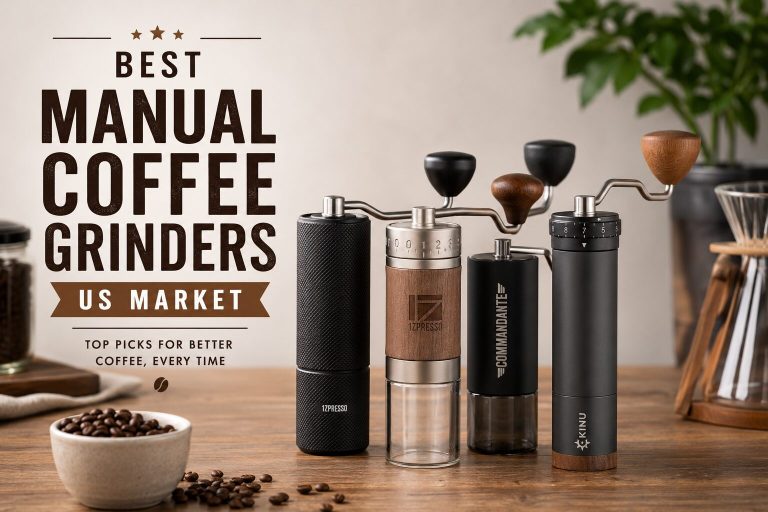
The Comandante C40 Hand Grinder Question
I should address the elephant in the room: can a hand grinder actually produce espresso-quality grounds? The Comandante C40 is often cited as proof that it can, and it does produce excellent particle distribution. After months of morning brews with the C40, I found it produces more consistent results than several electric grinders in the $200-400 range.
But here’s what the enthusiast forums don’t tell you: hand grinding for espresso is genuinely exhausting. A typical double shot requires 40-60 rotations at a moderate pace. For one or two drinks, it’s fine. For three or more, your forearm notices. The ritual argument is real—some people find the process meditative—but the physical reality is undeniable.
The C40 excels for pour-over and drip where coarser settings require fewer rotations. For espresso, it’s a viable option only if you’re willing to commit to the workflow.
Who should skip this: If you regularly make drinks for multiple people in the morning, or if you have any wrist or hand issues, the C40 becomes impractical for daily espresso. It’s better suited as a travel grinder or for someone making one drink per day maximum.
Lagom P64 and the Premium Segment
Moving into the $1,000+ range, the Lagom P64 represents a different design philosophy: maximum particle consistency, minimal retention, and workflow that prioritizes quality over convenience. The 64mm flat burrs produce exceptionally uniform grounds. The gravity-fed design minimizes retention pathways.
For most home users, the P64 is overkill. The differences between a well-tuned Mignon and a P64 are detectable in careful tasting but don’t transform your daily espresso experience the way the jump from a blade grinder to a quality burr design does.
That said, if you’re roasting your own coffee and chasing the last 5% of what your beans can offer, the P64’s precision becomes meaningful. After years of equipment upgrades, I can taste the difference in a blind comparison. Whether that difference is worth the price premium depends entirely on your priorities and budget.
Who should skip this: If you’re still dialing in your technique, buying a P64 is premature. The improvements it offers are refinements on top of consistent extraction—you need consistent extraction first.
What Didn’t Make the Cut
A few grinders came close but didn’t make the final recommendations.
The Baratza Encore came up frequently in my research as a budget entry point, and for blade grinder refugees, it’s a revelation. But for anyone serious about espresso, the particle distribution just isn’t tight enough. I kept getting inconsistent shots despite dialing in carefully. It’s a fine drip coffee grinder. It’s not an espresso grinder.
I also spent time with several turbo-cyclone style grinders that promise commercial-grade performance at home. The retention numbers looked good on paper. In practice, the particle distribution varied more than I’d accept, and the build quality didn’t inspire confidence for daily use over years.
The point isn’t that these grinders are bad—they’re fine for their price points. The point is that the recommended grinders above earned their spots by performing consistently over extended use, not just in specs or first-week impressions.
Common Mistakes Buyers Make
Buying a machine before a grinder. This is the most common error I see. New home baristas see gleaming espresso machines in showroom photos and prioritize them over grinders. The result is often a beautiful machine producing mediocre coffee. If you’re starting from scratch, buy the best grinder you can afford first. A modest machine on a quality grinder will outperform a premium machine on a mediocre grinder.
Underestimating retention. Grinder marketing often emphasizes particle consistency while glossing over retention. If you’re pulling shots with coffee that’s been sitting in the grinding pathway for 18 hours, your extraction will suffer regardless of particle quality. Understanding a grinder’s retention characteristics—and being willing to adapt your workflow to minimize it—is essential.
Chasing burr type over build quality. Conical versus flat is a real consideration, but build quality matters more. A well-made conical burr grinder from a reputable manufacturer will outperform a poorly-made flat burr grinder every time. Before choosing between burr types, ensure you’re comparing quality levels.
Ignoring workflow sustainability. The best grinder is the one you’ll actually use consistently. If single-dosing sounds tedious to you, a hopper grinder with acceptable retention is probably better than a single-dose grinder you’ll resent using. Espresso quality matters, but not if the friction drives you to make worse coffee because you avoid using the equipment.
Assuming higher price means better for their needs. A $1,500 grinder isn’t necessarily better than a $500 grinder—it might just be louder, larger, and more demanding to maintain while offering performance that’s only incrementally better. Matching grinder characteristics to your actual use case matters more than buying the most expensive option.
FAQ: Grinder Questions Worth Asking
Does burr size matter for home use?
Larger burrs generally produce more consistent particle distributions because they offer more cutting surface area. For home espresso, 40-50mm is typically sufficient. Going larger (60-64mm) improves consistency but also increases cost, size, and sometimes noise. If you’re grinding for pour-over or drip, smaller burrs are entirely adequate.
How often should I replace burrs?
Steel burrs dull with use. For home users grinding daily, expect 2-3 years before noticeable degradation in particle consistency. Commercial users might see wear in months. Watch for increased fines, inconsistent particle sizes, and shots that are harder to dial in despite correct technique.
Should I clean my grinder, and how often?
Yes. Coffee oils go rancid and affect flavor. I recommend a thorough cleaning every 2-4 weeks depending on usage. Burr grinders benefit from brush cleaning and periodic deep cleans with specialized cleaning beans. Avoid water in the grinding chamber—compressed air and a brush are safer for internal components.
Do expensive grinders really sound better?
Particle consistency is audible in the grinding sound to some extent—higher-pitched, more consistent sounds often indicate better cutting geometry. But sound quality is not a reliable indicator of grind quality. Use your taste buds as the final judge.
The Bottom Line
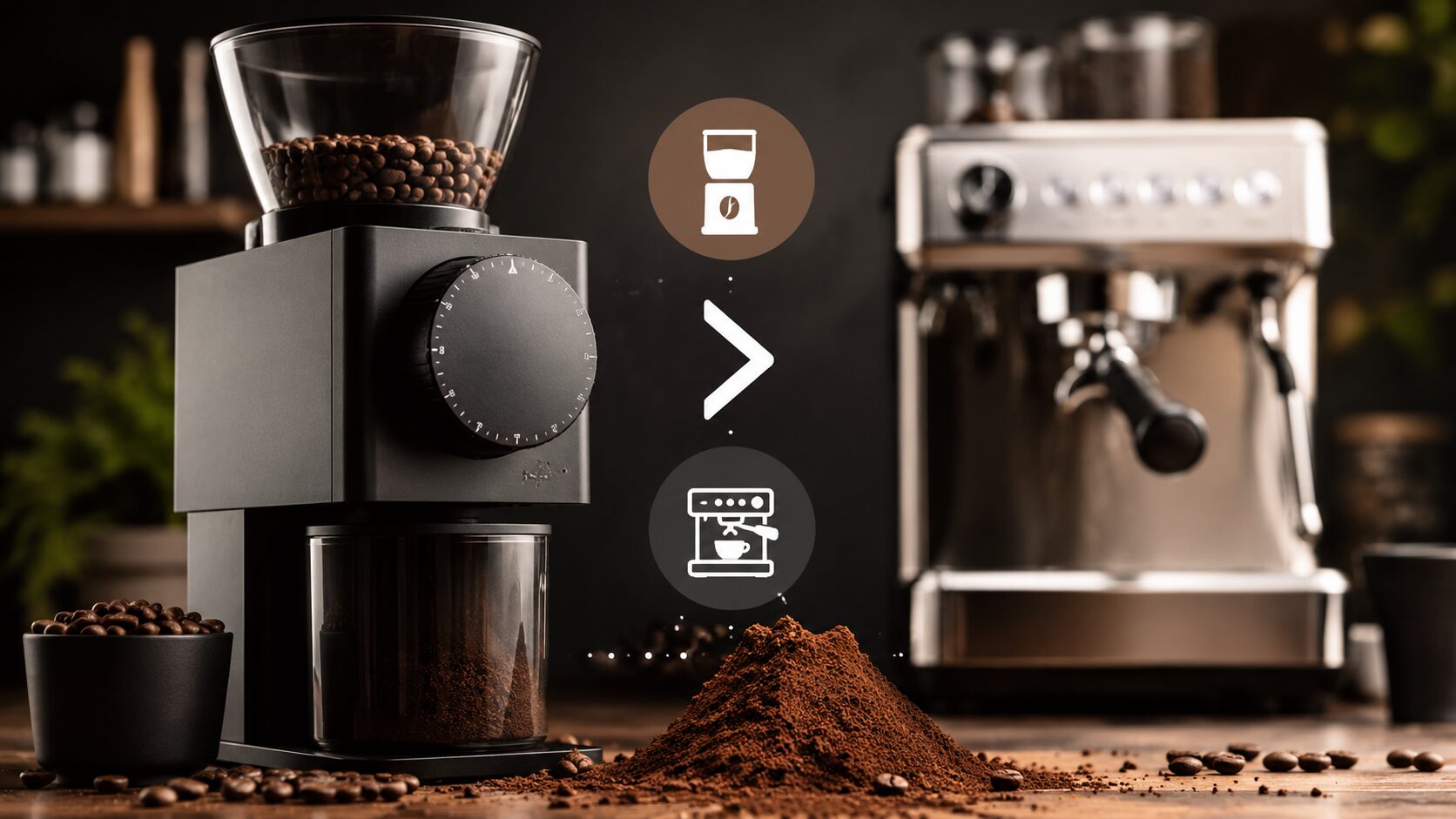
Here’s what I want you to take away from this: the grinder is not an accessory to your espresso machine. It’s the foundation.
When you understand that extraction is fundamentally a surface area problem, and that inconsistent particle sizes create unpredictable extraction behavior, the equipment hierarchy becomes clear. A good grinder gives you control. A good machine gives you convenience and refinement.
Before your next equipment purchase, ask yourself: where is my current bottleneck? Am I getting inconsistent shots despite dialing in my grinder? Am I spending time chasing flavors that should be obvious? The answer is probably not in a new machine.
Start with the grinder. Dial it in. Taste the difference. And then decide whether your machine is truly the limitation, or whether it’s something else entirely—bean freshness, water quality, workflow habits, or expectations that don’t match your current skill level.
Coffee as ritual means accepting that the craft is in the details. The grinder is where most of those details live.
This article is part of our Third Wave Tested, Roast Date Matters series. For related reading on water chemistry and extraction, see our guide to brewing water fundamentals.
As an Amazon Associate, I earn from qualifying purchases.